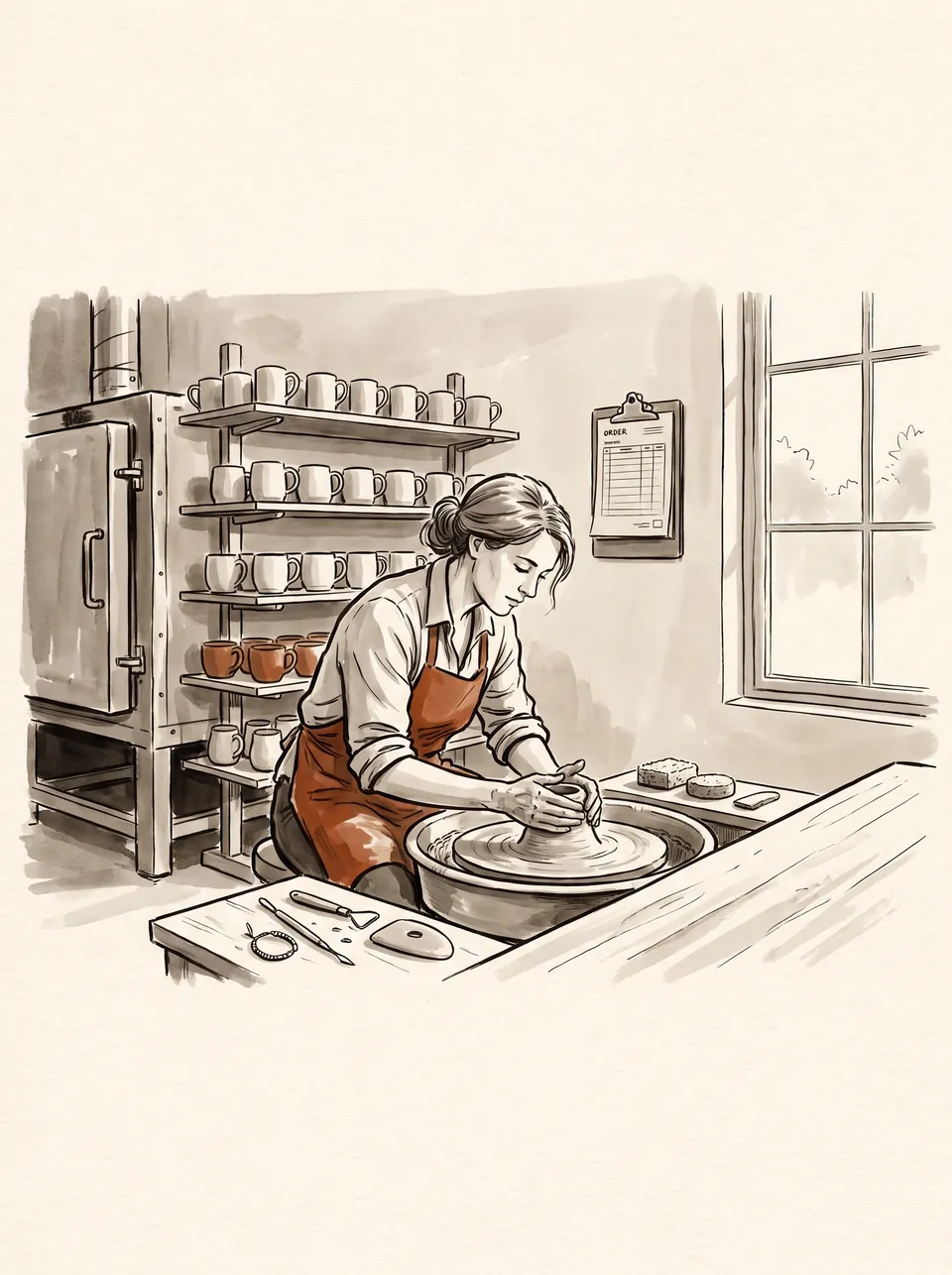
Start with the smallest possible business.
One person. One product. One customer. No employees, no managers, no departments, no org chart. A potter who makes a single style of mug and sells it at a farmer's market. The specific product is interchangeable. The structure is not.
We are not looking for six. We are looking for whatever functions must exist for the business to survive. If the number were five or seven, the method would reveal it. This is the right place to begin because every complication in the rest of this book grows from this seed. A 100,000-person company is not a different kind of organism from the potter at the farmer's market. It is the same organism, scaled. The functions are identical. The complexity of each function is what changes. If you can name the functions correctly at the smallest scale, you can recognize them at any scale, in any industry, in any era.
So let us watch the potter.
It's Saturday morning. She loads her car with a folding table, fifty mugs, two batches' worth, a cash box, a card reader, and a sign she made the night before. She drives to the farmer's market, sets up her booth, and waits.
Already, she has performed three functions without naming any of them.
She made the mugs. Each one started as a lump of clay and became, over weeks, a finished object someone might want to own. This is the first function. We will call it Value Creation. Notice the name. It is not "production" and not "making things." It is the configuration of resources, including time, skill, and material, into something a buyer will pay for. The emphasis is on the last clause. A mug nobody wants is not Value Creation. It is a sculpture, or a hobby, or a mistake.
She got the mugs to the market. She loaded them, drove, set up the booth, arranged the inventory, and made the product physically available to the people who would buy it. This is the second function. We will call it Value Delivery. For the potter, delivery is logistics and presentation. For Apple, delivery is a global supply chain and services ecosystem, retail stores, packaging engineering, and quality control. Only the complexity changes.
She brought the cash box and the card reader. When a customer taps a phone, the value she created and delivered converts into resources she can use to make the next batch. This is the third function. We will call it Value Capture. Capture is not the same as Creation. A mug given away for free has been created and delivered. It has not been captured. Capture is the conversion of delivered value into retained resources, the oxygen that funds the next cycle of everything else.
Three functions are running. Three more are about to appear, because the first three are insufficient on their own.
The morning passes and three people walk by the booth. A woman pauses, picks up a mug, sets it down, and keeps walking. A man glances at the table without slowing. By eleven o'clock, the potter has sold two mugs. She has fifty and the market closes at two.
She has a demand problem. People who would love her mugs are walking past without knowing it. The product is excellent. The price is reasonable. None of that matters if the people who would buy don't realize they're looking at exactly the thing they have been wanting. This is the fourth function. We will call it Demand Generation. For the potter, it might be a better sign, a printed card, a conversation with each person who slows down. For a software company, it might be content marketing, paid acquisition, and word of mouth. Without it, no amount of Creation, Delivery, and Capture combined will produce a viable business.
She sells ten more mugs in the afternoon, partly because she stood in front of the table and engaged the people who slowed down. She drives home with thirty-eight mugs unsold and just over three hundred dollars in her cash box.
Sunday morning, she sits at her kitchen table and notices something. The mugs that sold were the ones with the lighter glaze. The dark ones sat all day. A customer mentioned the handle didn't fit her left hand. A teenager asked about pastel colors. None of these signals are demands. They are pieces of information about how the market is shifting. This is the fifth function. We will call it Adaptation. Adaptation scans the environment for signals and translates them into changes in the business. It does not decide what to do. It surfaces what has changed. The decision belongs to Coordination.
A business that performs Creation, Delivery, Capture, and Demand Generation flawlessly and never adapts will eventually be overtaken by a business that adapts. Kodak invented the digital camera inside its own labs in 1975 and could not metabolize the future it had created; the Adaptation chapter tells that story in full.
Five functions are running. The potter sits at her kitchen table and feels something that hasn't been a problem until now.
The five functions are pulling against each other.
Adaptation is whispering that she should redesign the mug for a left-handed grip, which would require her to throw away the molds she just paid for. Capture is reminding her those molds cost six hundred dollars. Creation wants to spend two weeks experimenting with pastel glazes. Demand Generation wants the new mugs ready for next Saturday. Delivery wants her to stop changing the lineup so returning customers can find what they bought.
Each function is doing its job. Each one is right, on its own terms. And they can't all win. Someone has to decide which signal gets prioritized this week, which trade-off is worth making. For the potter, that someone is herself. She holds the conversation between the functions inside her own head.
This is the sixth function. We will call it Coordination. Coordination resolves the natural, structural tensions between the other five. A business with no tension between its functions is a business where one function has gone silent, and that silence will eventually become a crisis. Coordination decides which of the five gets the next hour, the next dollar, the next conversation, and what happens when two of them disagree about what the business should do next.
Six functions. One weekend. The potter performed all of them without naming any of them.
A clarification before we proceed. These are not six categories of business activity. They are not departments, roles, or steps in a sequence. They are six irreducible functions a business must perform to remain alive. Some transform value. Some regulate the conditions under which value can keep being transformed. All six are equally load-bearing. Remove any one and the organism dies.